All you can eat
The takoyaki feast
Cook and eat
- Length2 hours
- CancelFree until 24 hours before
- Host languagesChinese, English, Japanese, Korean
Tap-to-check list
Checklist · 9 tasks
Check things off as you go; your progress is kept on this device.
0 / 9 ready
You are good to go. Only the day is left: your appetite and the meeting spot.
Reserve a spotOsaka's food culture has its own vocabulary and its own favorites. This guide walks through the dishes the city claims, what makes each one Osaka's, and where in town to look for it.
Editorial team, osakafood.quest · Updated November 6, 2026 · 6 min of reading
Key facts
Osaka has a word for its attitude to eating: kuidaore, to eat to your heart's content. Osaka's tourism bureau traces it to a bottom-up food culture, built by people who cooked for their families and for guests.1 That attitude explains why a first list of foods in Osaka is long, and why locals argue about which stall does it best. The arguments are part of the pleasure, and they start the moment you ask someone for a recommendation.
History fed the habit. During the Edo period ingredients from all over the country were gathered in Osaka, which earned the city the nickname the kitchen of the world.5 Merchants used restaurants for business negotiations, and chefs honed their skills as a result, so cuisine grew more refined.6 The two sides, rough street snacks and careful restaurant cooking, still sit a few minutes apart.
Under almost everything is dashi. Osaka's version is made from kelp from Hokkaido and bonito flakes from Tosa, and the anchovies of Osaka Bay and the Seto Inland Sea made cheap dried sardines available as well.7 You taste that stock in the udon, in the batter of the flour dishes and in many sauces. Learn to notice it and the whole menu starts to make sense.
The dishes at a glance
| Dish | What it is | Where to look |
|---|---|---|
| Takoyaki | Flour and dashi batter with octopus21 | Stalls around the Minami area22 |
| Okonomiyaki | Cabbage pancake cooked on a griddle17 | Specialty shops in Minami22 |
| Kushikatsu | Breaded, fried skewers3 | Janjan Yokocho, Shinsekai12 |
| Kitsune udon | Udon with sweet fried tofu23 | Dashi-led udon shops across the city24 |
| Box sushi | Pressed sushi from a wooden mold4 | Local sushi restaurants25 |
| Omurice | Omelet wrapped around ketchup rice26 | Western-style restaurants in the city26 |
| Tonkuman | Steamed pork bun27 | Bun shops across Kansai27 |
The bureau's pages describe each dish, and the places listed are the areas it names.28,22
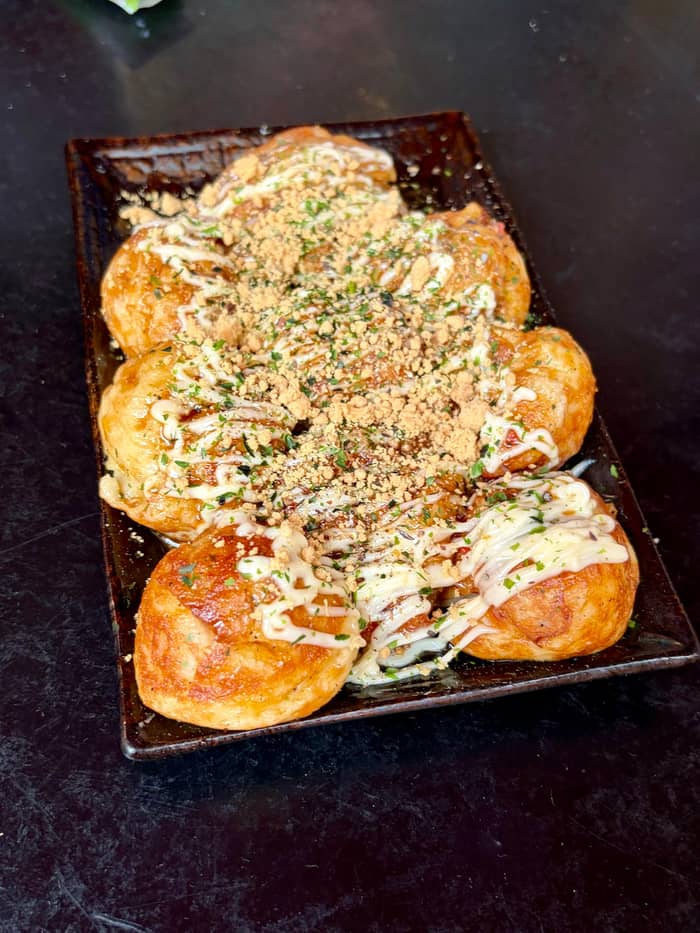
In Kansai wheat flour is often used in cooking, and Osaka is known for okonomiyaki, takoyaki and udon noodles.2 Osaka's tourism bureau groups the cheap street versions as konamon.14 Takoyaki is the one to eat standing at a stall: shops selling it only began to appear in the city in the 1950s, and octopus from Osaka Bay was used fully without waste.11,15 Good takoyaki is crispy on the outside and soft and gooey on the inside.16
Okonomiyaki is the sit-down cousin. It is made by dissolving flour in dashi, cabbage is a must, pork is popular, and you can add whatever you like.17 The Osaka version uses mountain yam in the batter for a fluffy texture, and at many shops the staff cook it for you instead of you cooking it yourself.18,19 Visitors are often surprised that Osakans eat it as a side dish with rice.20
Both dishes get their own page on this site, with the Hiroshima comparison and the stalls to try. For now, a rule of thumb: eat takoyaki outdoors while it is hot, and save okonomiyaki for a counter where the griddle is in front of you. Japan's tourism board notes that okonomiyaki restaurants are popular for after-work dinners, so lunchtime is the way to avoid a wait.10
Or cook it yourself
Each bar is the from price of a GetYourGuide listing; the classes last 1.5 to 2 hours.
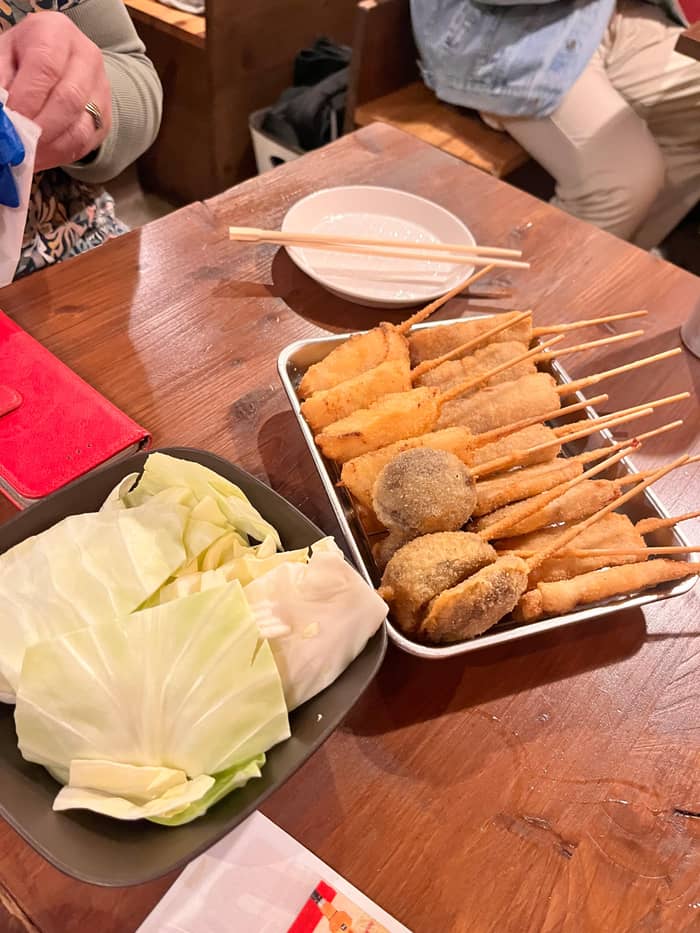
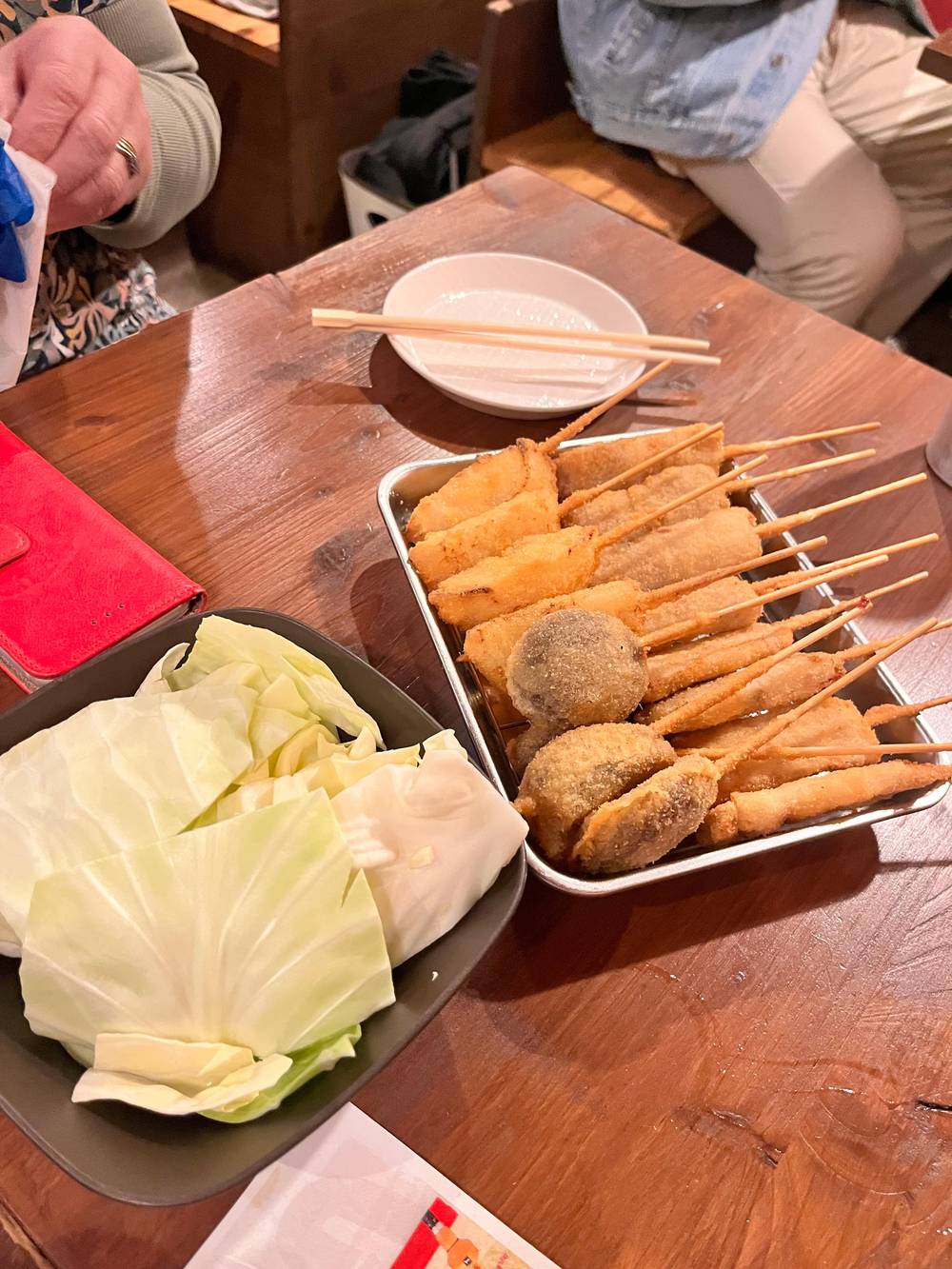
Kushikatsu is meat and vegetables on skewers, coated in a batter of flour and water and breadcrumbs, then deep-fried, and it is famous for its no double dipping rule.3 At a counter you may not dip a bitten skewer into the shared sauce again, but you can eat as much cabbage as you like, and the skewers include beef, shrimp, asparagus, eggs and cheese.31 The bureau says Shinsekai is where to look, with Janjan Yokocho known as the town of kushikatsu.12
Udon is Osaka's gentle answer to the fried food. The appeal of Osaka udon lies in the harmony of soft noodles and a gentle dashi made from kelp and bonito flakes.29 Kitsune, the sweet and spicy stewed fried tofu on top, was born in Senba, Osaka during the Meiji period, and the bureau says Osaka's kitsune udon stands out because of its carefully chosen dashi.23,24
Osaka famous food also includes a wider variety of curry than other regions, according to the bureau, and yakiniku is starting to be recognized as a new staple dish among foreign tourists.32,33 If you have only one day, do not try to eat all of it. Pick one fried thing, one flour thing and one bowl, and leave room for a second visit.
A short chooser
You cannot eat everything. Start with what you feel like and work outward.
If I want something quick and hot
Takoyaki from a stall
It is a classic fast food sold from stalls.11
If I want something I can sit down to
Okonomiyaki at a griddle
Osaka shops often cook it for you.19
If I want to try many small things
A food walk in Shinsekai
Ours covers 18 foods and 3 drinks at 4 eateries.
If I want something gentle
Kitsune udon
If I want something Osaka invented
Conveyor belt sushi or omurice
Learn it by making it
All you can eat
Cook and eat
Two dishes
Nanba kitchen
Small group
Tasting and cooking
Osaka sushi is not Tokyo sushi. The representative sushi of Osaka is box sushi, a pressed sushi where ingredients and vinegared rice are pressed into a solid form in a wooden mold.4 Mackerel topped with pickled kelp is called battera, a word taken from the Portuguese for small boat.25 It is quiet food, neat and sliceable, and it is a fine contrast to a day of sauce and mayonnaise.
Conveyor belt sushi also began in Osaka: the first such restaurant opened in 1958.30 Omurice, the omelet wrapped around ketchup rice, is said by one theory to have originated in Osaka in 1925, when a restaurant owner wrapped ketchup rice in a thin omelet for a regular customer with an upset stomach.26 Both are the kind of invention a city makes when it enjoys eating more than it enjoys tradition.
Then there are the buns. In Osaka the word meat means beef, so the pork buns that elsewhere carry a Kanto-style name are called tonkuman in Kansai.27 Buy one at a station or a shop and eat it warm. For a sweeter stop, a depachika, the basement food floor of a department store, lets you point at what you want.36
Eat it or cook it
Choose how many are coming and compare the from price of a walk with three cooking classes.
4 options compared
Choose how many are coming and compare the from price of a walk with three cooking classes.
≈
View≈
View≈
View≈
ViewConverted at the ECB reference rate, from-prices as listed by GetYourGuide. The precise amount is shown when you book.
One day of eating
Morning
Convenience stores stock onigiri and are mostly open 24 hours, and stand-up noodle shops sell by meal ticket.8,9
Lunch
Lunchtime avoids the after-work crowd at okonomiyaki restaurants.10
Afternoon
Takoyaki is a classic fast food sold from stalls.11
Early evening
Janjan Yokocho is known as the town of kushikatsu.12
Dinner
Our Shinsekai walk offers 18 foods and 3 drinks in 3 hours.
Late
Ura-Namba is known for standing bars.13
Japan's tourism board points to a few easy ways to eat well on a budget. Convenience stores stock kara-age, onigiri, bento boxes and snacks, and most are open 24 hours.8 At stand-up noodle shops you may need to buy a meal ticket from a vending machine first.9 Menus are often illustrated with photographs, and touch-panel ordering in many places makes choosing easier.37
After dark the options widen. Izakaya serve a huge variety of dishes, typically tapas-style in small portions to go with drinks.34 Osaka's tourism bureau says Ura-Namba has been a bar-hopping spot since around 2010 and is known for standing bars once reserved for older men and now popular with young people and women alike.38,13 Hozenji Yokocho, a lane about 100 meters long, is lined with kappo, yakitori, oden and sushi restaurants and bars.39
These are the places to eat when you have already had the famous dishes and want to spend an evening instead of a snack. A guided walk is one route into them, and ours spends 3 hours among the eateries of Shinsekai with 18 foods and 3 drinks. A solo evening works too if you are patient with menus and a translation app.
Video
Abroad in Japan on YouTube · The clip loads only after you tap play.
The appeal of Osaka udon lies in the harmony of the soft noodles and the gentle dashi made from kelp and bonito flakes.
Osaka's tourism bureau says okonomiyaki and takoyaki can be found in abundance in the Minami area, while kushikatsu restaurants cluster in the Shinsekai area around Tsutenkaku Tower.22,28 Dotonbori street itself is lined on both sides with restaurants of various genres that are crowded throughout the year.40 Treat that crowd as normal and go early or late.
The dishes also change with the season. Japan's tourism board says autumn is a great time to taste what is in Japan's larder, and in winter suggests hot sake and a bowl of bubbling hot-pot.41,42 Summer in Osaka is very humid, which favors cold noodles, shaved ice and a lot of drinking water.43 Plan the heavy fried food for the cooler evenings.
A last word on manners. Tipping is not customary in Japan, and saying arigato to the staff is fine.44 Some markets ask you not to eat or drink while walking, so finish your skewer at the stall.45 Learn those two habits and you will fit in wherever you eat.
FAQ
Shops selling takoyaki only began to appear in the 1950s, and it is a classic fast food sold from stalls on the street.11
There is no custom of leaving tips in Japan.44
Sources
More to read
Questions about the Shinsekai food walk? A real person replies here.