Cook and eat
The takoyaki feast
All you can eat
- Length2 hours
- CancelFree until 24 hours before
- Host languagesChinese, English, Japanese, Korean
Price for your party
The short version
Takoyaki are octopus balls in a flour and dashi batter, and okonomiyaki is a cabbage pancake cooked on a griddle, both classic Osaka street food.
The essentials
4 options compared
Choose how many are coming and see the from price of each option added up.
≈
View≈
View≈
View≈
ViewConverted at the ECB reference rate, from-prices as listed by GetYourGuide. The precise amount is shown when you book.
Two hot-plate dishes carry Osaka's street food reputation. Learn what goes into each, how Osaka's pancake differs from Hiroshima's, and how to eat them hot without regrets.
Editorial team, osakafood.quest · Updated November 6, 2026 · 6 min of reading
Key facts
Kansai cooks use wheat flour more than most regions, and Japan's tourism board names okonomiyaki, takoyaki and udon as the dishes Osaka is known for.8 Osaka's tourism bureau calls the cheap and delicious street versions konamon, a major part of Kansai food culture.9 If you only have room for two flour dishes, take Osaka street food takoyaki, the octopus balls the city made famous, and okonomiyaki, the cabbage pancake.
The shared secret is dashi. Takoyaki dissolves flour in dashi instead of water and adds octopus, which turned a children's snack into something adults enjoy too.2 Okonomiyaki also dissolves flour in dashi, treats cabbage as a must and lets the cook add whatever you like.3 That stock is why both taste savory before any sauce arrives.
Both also share a sauce habit. Eating takoyaki with sauce, mayonnaise, green laver and bonito flakes is said to have been influenced by okonomiyaki after the war.10 So when you taste the sweet-sour sauce on either plate, you are tasting one idea cooked two ways. The rest of this guide takes them apart.
Four flour dishes compared
| Dish | How it is built | Where it comes from |
|---|---|---|
| Osaka okonomiyaki | Mixed batter with yam and cabbage4 | Osaka, Kansai8 |
| Hiroshima okonomiyaki | Layered over noodles15 | Hiroshima16 |
| Tokyo monjayaki | Runnier batter, much more dashi17 | Tokyo17 |
| Takoyaki | Octopus in dashi batter, turned into balls2,11 | Osaka13 |
| Akashiyaki | Soft, in a clear broth14 | Akashi City, Hyogo14 |
The dishes are described by Osaka's tourism bureau and Japan's tourism board.14,17
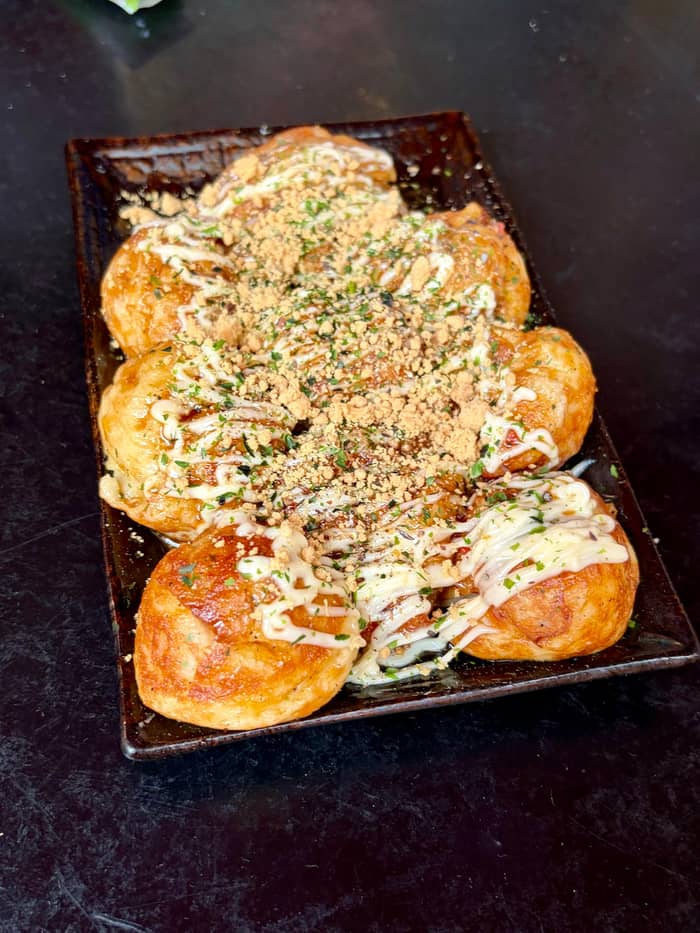
Takoyaki is a classic Osaka fast food sold from stalls, and shops selling it only began to appear in the city in the 1950s.1 At the time octopus was caught in large quantities in Osaka Bay, so the dish used the octopus fully without waste.12 The bureau also says takoyaki grew out of choboyaki and radioyaki snacks, and that nobody agrees on who invented it.
Watching a cook at work is half the fun. At a stall the cook flips the takoyaki round and round with an awl to make it into balls.11 The balls arrive lined up on a bamboo boat, and you poke them with a toothpick and eat them hot.6 Japan's tourism board adds that takoyaki originated in Osaka and is now a nationwide favorite in almost any shopping arcade or festival.13
Akashiyaki is the regional cousin, from Akashi City in Hyogo Prefecture: a soft takoyaki-like dish served on a wooden plate and eaten dipped in a clear broth.14 If you meet it on a menu, expect something eggier and gentler than the sauce-covered balls of Osaka. Both are worth trying, and the contrast says a lot about how one idea changes with the cook.
Hands-on or hands-off
All bars are from prices on the listings and the walks include more than flour dishes.
Good takoyaki is crispy on the outside and soft and gooey on the inside, which is exactly why the first bite can scald.7 Hold the toothpick, let the ball sit for a moment, then bite it in half so steam escapes. Do not swallow it whole to impress the stall owner; locals blow on it too.
Eat it where you bought it. Japan's tourism board notes that some markets may ask you not to eat or drink while walking, and a stall counter or a nearby stand is the polite place to finish a tray.21 Keep a napkin handy for the sauce and mayonnaise, and say a quick thank you when you pay.
Order by the tray, not by the ball, and share. A first visit goes best if two or three people split one tray and then move on to a different stall; the point is to compare. Most stalls will let you choose between sauce, mayonnaise and a plain finish, so say what you want while the cook is still pouring.
A short chooser
Decide whether you want to watch, eat or cook, then match the dish.
If I want a snack on the move
Takoyaki from a stall
It is sold on a bamboo boat and eaten hot with a toothpick.6
If I want a proper sit-down
Osaka okonomiyaki at a counter
Staff at many shops cook it in front of you.18
If I want to cook it myself
A class or a cook-your-own table
At most Osaka restaurants you can cook your own.4
If I want to compare styles
Osaka and Hiroshima in turn
Hiroshima layers batter, noodles and toppings.5
If I want a keepsake
A pan from Doguyasuji
It has the best utensil selection in Japan.19
Learn it by making it
Cook and eat
All you can eat
Two dishes
A kitchen in Nanba
Small group
Tasting and cooking
Osaka-style okonomiyaki mixes the batter ingredients, including grated yam and shredded cabbage, in a bowl and pours them straight onto the hot griddle like a pancake.4 Mountain yam in the batter gives it a fluffy texture.20 It is cooked on an iron griddle and topped with sliced pork, a savory-sweet sauce, Japanese mayonnaise and aonori seaweed powder.25
You can often cook your own: at most Osaka restaurants that option exists, but at many specialty shops the owner or staff cook it for the customer.4,18 The dish became known nationwide as an Osaka specialty with the 1970 Osaka Expo.23 It is eaten as a side dish with rice in Osaka, which often surprises visitors from elsewhere.26
Japan's tourism board points out that okonomiyaki restaurants are popular for after-work dinners, so a lunchtime visit means a shorter wait.22 Plan on sitting at a counter where the griddle is in front of you; that is where the dish is at its best, and where you can ask what the toppings are in your own words.
A tray of takoyaki, step by step
The batter
Flour is dissolved in dashi instead of water.2
The octopus
Octopus is added to the batter in the pan.2
The flip
The cook turns the takoyaki with an awl until it forms balls.11
The sauce
The toppings are said to follow okonomiyaki's example.10
The tray
Takoyaki comes lined up on a bamboo boat.6
The bite
Good takoyaki is crispy outside and soft inside.7
Osaka's rival is Hiroshima. Hiroshima okonomiyaki is layered rather than mixed and includes noodles, and it is flipped on top of the noodles and cooked until crispy.15 The tourism board says the ingredients are layered, first batter, then noodles, then toppings, and professionals usually prepare it for you.5
Hiroshima takes the dish seriously. There are more than 800 restaurants serving the local version, most of them small with about a dozen counter seats.16 At Okonomimura prices start from around 800 yen for a basic okonomiyaki with noodles, egg and meat.27 If you plan to go, compare it with Osaka's pancake on the same trip; the difference is clearer than any description.
Tokyo's monjayaki is a third dish: a runnier one, because its batter contains much more dashi than other okonomiyaki styles.17 Eating each in its home city is the traditional way to settle the argument, and you do not have to pick a winner. Osaka only asks that you try its version hot.
Video
Japanese Food Insider on YouTube · The clip loads only after you tap play.
Another distinctive feature of Osaka okonomiyaki is that it is made with mountain yam mixed into the batter to create a fluffy texture.
Before you eat
Osakans are said, almost like an urban legend, to keep a takoyaki maker in every household.28 That helps explain classes in the city. A GetYourGuide listing offers a takoyaki making session with all you can eat and drink for 2 hours from $35, a Nanba class on okonomiyaki and takoyaki lasts 2 hours from $70, and a sake tasting with takoyaki cooking lasts 2 hours from $70.
Utensils make a souvenir. Doguyasuji, a 150 meter shopping street a 3-minute walk from Namba Station, has the best selection in Japan of cooking utensils for flour-based food such as takoyaki and okonomiyaki.29,19 A home takoyaki pan is a sensible thing to carry back if you want to repeat the trip.
Or let someone else do the work. One Viator walk through Dotonbori and Shinsekai lists 1 piece of okonomiyaki, a few pieces of takoyaki and a lesson in cooking okonomiyaki, from $109. Our own Shinsekai walk lasts 3 hours with 18 foods and 3 drinks, from $84. Pick the one that matches how much cooking you want to do.
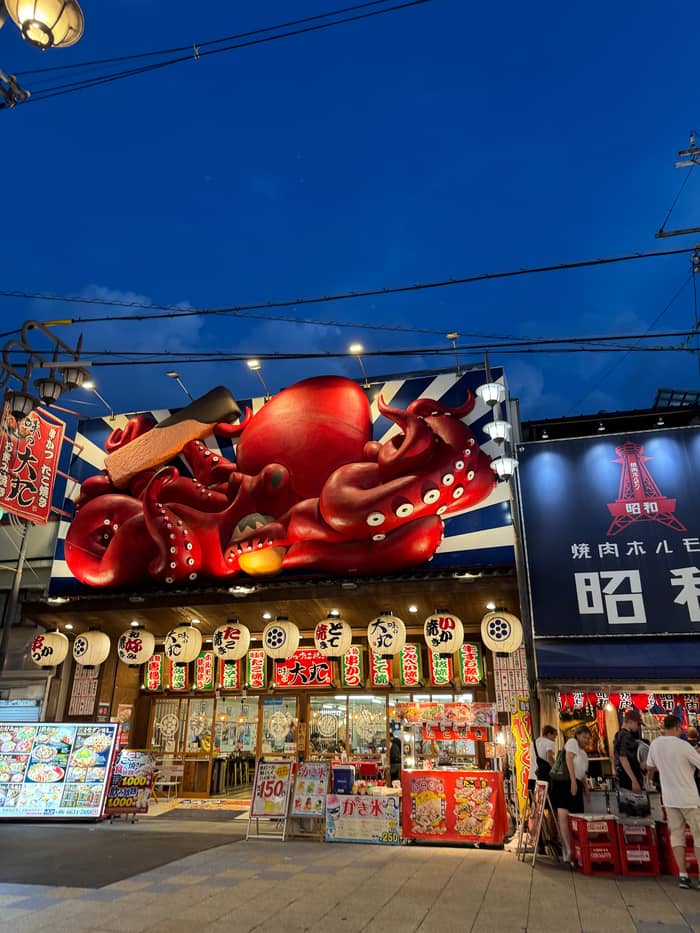
Osaka's tourism bureau says okonomiyaki and takoyaki can be found in abundance in the Minami area.30 Dotonbori street is lined on both sides with restaurants of various genres that are crowded throughout the year.31 Hozenji Yokocho, a lane of about 100 meters, and Ura-Namba, a bar-hopping district, sit close by for a break from the main crowd.32,33
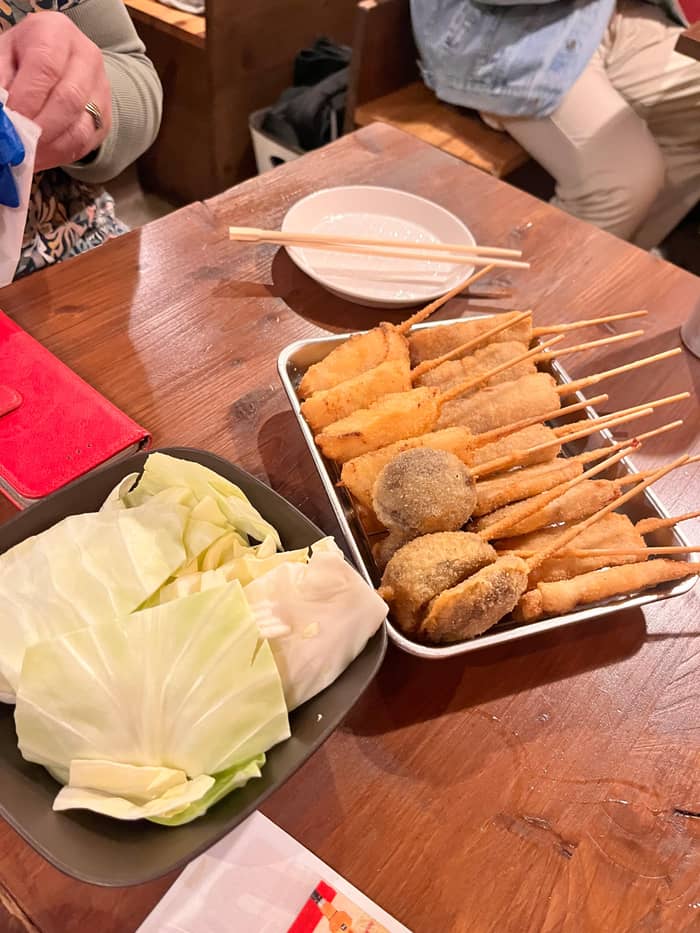
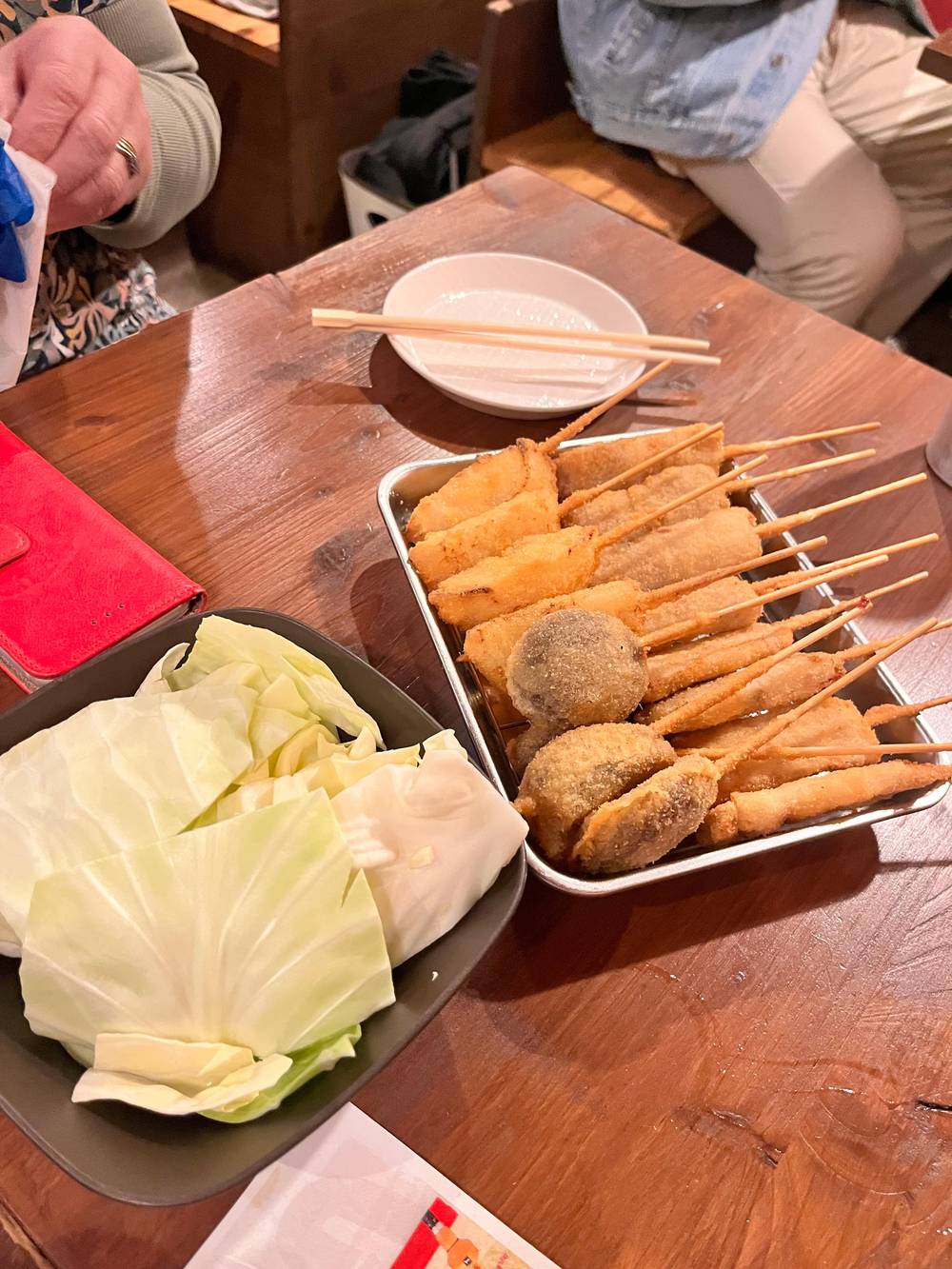
Not every food tour serves these dishes. One Viator tour lists karaage, yakitori, takoyaki, udon, oden, kushikatsu and dessert across 5 eateries, from $84. Ours lists 18 local foods without naming them, so ask the operator beforehand if takoyaki or okonomiyaki is the thing you came for. A listing that names its dishes is easier to plan around.
Whichever route you take, carry some cash, since Japan still has many places where cash is required.34 Come hungry but not starving, because a hot tray arrives faster than you expect and a second stall is always tempting. Leave room for something sweet at the end, and for the walk back to the station.
FAQ
Osaka's tourism bureau says shops selling takoyaki only began to appear in the city in the 1950s.1
The bureau lists them together as konamon, a major part of Kansai food culture.9
JNTO notes you may find a vegetarian okonomiyaki but it is not vegan because of egg.35
Sources
More to read
Questions about the Shinsekai food walk? A real person replies here.