The site's walk
Guided food walk
A guide picks the stops
- Length3 hours
- Eateries4 stops
- GroupUp to 15
Find a stop on the map
Hungry Osaka Street Food Tour Shinsekai:15 Tastings 3 Drinks
★ 4.9 · 1,772 guest reviews
View 18 stops
Pick a route, then tap a marker or a stop for notes and a Google Maps link.
The second tower is 108 meters tall, including the lightning rod.
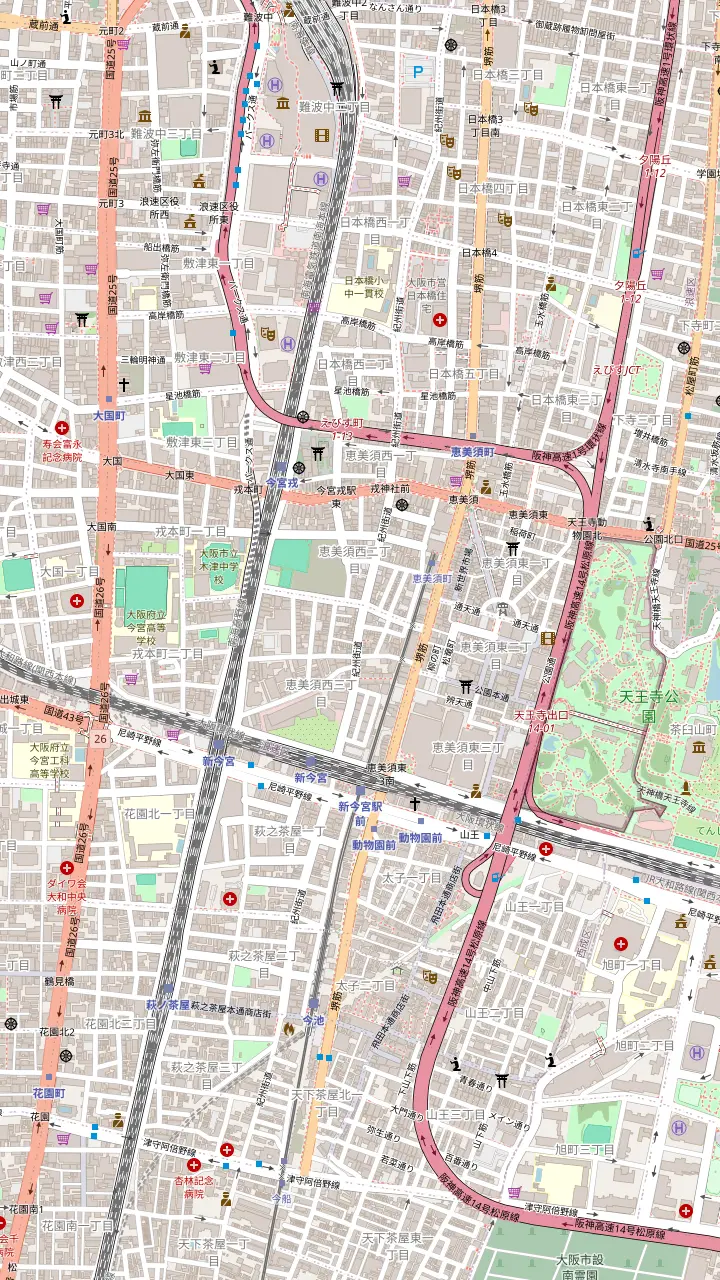
Google MapsAbout 180 meters of kushikatsu shops and other eateries.
Google MapsA 5-minute walk to Jan-Jan Yokocho; the guided food walk meets 1 minute from Exit 5.
Google MapsA 6-minute walk to Tsutenkaku from the JR Osaka Loop Line.
Google MapsA 3-minute walk to Tsutenkaku on the Sakaisuji Line.
Google Maps
A dining area on the first basement floor of Umeda Sky Building.
Google MapsKnown for yakiniku restaurants in its crowded backstreets.
Google MapsA culinary hub and the historic Korean Town of Osaka.
Google MapsA wholesale market a 3-minute walk from Daikokucho Station.
Google MapsThings kick into full swing around 6 PM.
Google MapsMost visitors come for the restaurants; kushikatsu is the signature.
Google Maps
Dotonbori is right outside Namba Station, with giant crabs, octopuses and pufferfish on its signs.
Google MapsA 100-meter alley of kappo, oden, yakitori and sushi restaurants.
Google MapsThe standing-bar district, with over 100 restaurants.
Google MapsAbout 150 stores under a 580-meter arcade.
Google MapsKitchen tools and food samples, 3 minutes on foot from Namba Station.
Google MapsThe station right outside Dotonbori, on the Nankai, Kintetsu and Osaka Metro lines.
Google MapsA riverside promenade that has become popular.
Google Maps© OpenStreetMap contributors, map data
Shinsekai is the neon district under Tsutenkaku tower where kushikatsu is the signature dish. Here is the history, the lane, the rules of the skewer and the walk this site recommends.
Editorial team, osakafood.quest · Updated November 6, 2026 · 6 min of reading
Key facts
Shinsekai means New World, and the name tells you what it was meant to be. The district was built as an amusement park in 1912.1 Japan National Tourism Organization writes that the northern half was modeled after Paris, with the Eiffel Tower-esque Tsutenkaku standing at its center,5 while the southern half was modeled after New York's Coney Island.6
That mixed parentage shows in the streets. You get neon signs, old arcades and a skyline that is dominated by one tall tower, and you can take in most of it from the lane. It is not a polished district. It is a lively one, built to attract crowds, and it still does.
For eating, the draw is simple, and Shinsekai street food mostly means fried skewers. JNTO says most visitors come to Shinsekai for the restaurants, since the area is famous for kushikatsu.7 The same page says Tsutenkaku and Shinsekai can easily fill a couple of hours of your schedule,8 which is a good reason to arrive hungry and leave plenty of time.
Arrival options
| Station | Line | Walk to | Time |
|---|---|---|---|
| Ebisucho | Osaka Metro Sakaisuji Line | Tsutenkaku | 3 minutes16 |
| Shin-Imamiya | JR Osaka Loop Line | Tsutenkaku | 6 minutes17 |
| Shin-Imamiya | JR Osaka Loop Line | Jan-Jan Yokocho | 5 minutes18 |
| Dobutsuen-mae | Sakaisuji and Midosuji Lines | Jan-Jan Yokocho | 5 minutes18 |
Walking times are those given by the Osaka Convention & Tourism Bureau.16,18
The first Tsutenkaku was built in July 1912 as the symbol of an entertainment facility called Luna Park, and it measured about 75 meters.9,10 A fire in January 1943 led to the original being dismantled,11 and the second tower was rebuilt in 1956 with the backing of the local residents.12
The second tower stands 108 meters tall, including the lightning rod.2 It is registered as a national tangible cultural property.14 On the golden observation platform you meet the Billiken statue, said to bring good fortune to those who touch the soles of his feet.15 It is a small ritual that suits a tower built for fun, and worth a minute even if you do not believe in luck.
If you want the view, the special outdoor observation deck is listed as open 9:00-21:45.13 That makes the tower a flexible add-on, since you can go up before a meal or after one. Climb it for the orientation, not for the food, and then come down to ground level where the real attraction is.
The lane that most people mean when they say Shinsekai food is the Nanyodori shopping street, known as Jan-Jan Yokocho. It stretches approximately 180 meters from the zoo subway station to Tsutenkaku Tower.3 The name is said to come from the shamisen and taiko drums played after the war to attract customers.20
The lane is flanked on both sides by a variety of stores, among them kushikatsu, yakiniku, sushi, udon and standing izakaya.19 That variety is what makes a short walk so rewarding. You can start with a skewer, move to a bowl of noodles and finish with a drink without ever leaving the same 180 meters.
There is one quieter attraction. Go and Shogi clubs thrive along the street, and the games can be watched through the glass windows.21 It is a small reminder that Shinsekai is a neighborhood before it is a food stage. Keep your voice down at the windows, and do not tap the glass.
Pick your style
Find the row that sounds like you and follow the answer
If I want a guide to explain the dishes
Book the guided walk
It lasts 3 hours with a live guide in English.
If I like choosing my own skewers
Walk Jan-Jan Yokocho
It is about 180 meters of eateries and counters.3
If I want the best view before dinner
Go up Tsutenkaku
The outdoor deck is listed as open 9:00-21:45.13
If I am worried about the dipping rule
Order with a guide
The guide explains how each shop works.
If I am coming on the Loop Line
Use Shin-Imamiya
Jan-Jan Yokocho is a 5-minute walk from it.18
Ways to do Shinsekai
The site's walk
A guide picks the stops
Self-guided
Order at the counters
See the guided walk
View plus meal
Deck and then dinner
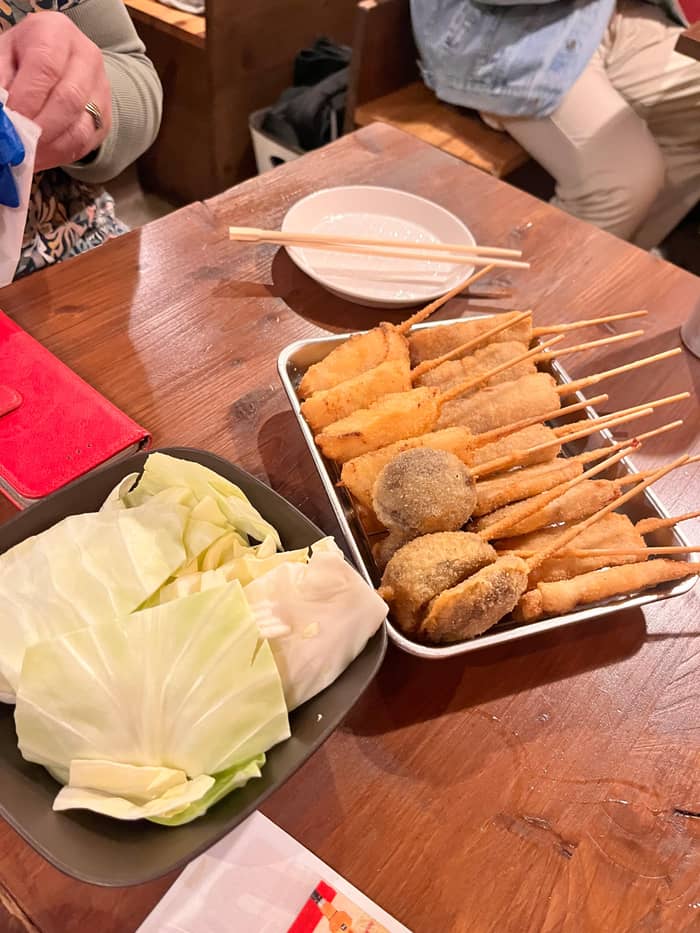
See the guided walkKushikatsu street food in Osaka goes back to 1929, when food vendors began selling skewered meat dipped in batter to local laborers as a cheap but filling meal.36 Meat and vegetables are skewered, coated in a batter of water-dissolved flour and breadcrumbs, and deep-fried.37
JNTO explains why it feels different from tempura: the batter is a lot lighter, made with water, flour and eggs.38 The main ingredients can be eggs, mochi, innards, meat, seafood and a wide assortment of vegetables,39 so a table of skewers can cover a whole menu. Shinsekai has lines of stalls dedicated to serving kushikatsu.40
A few practical notes follow from the cooking. Kushikatsu is cooked upon ordering to keep it crispy and hot,35 which means you should order in rounds and eat each skewer when it arrives. A side of raw cabbage typically comes with it,34 and JNTO suggests a cold beer or melon soda as the drink to go with it.41
The tower's life
July 1912
It was built as the symbol of Luna Park and measured about 75 meters.9,10
January 1943
After a fire, the original Tsutenkaku was dismantled.11
1956
Local residents backed the rebuilding of the tower.12
Today
The second tower is 108 meters tall including the lightning rod.2
Daily
The special outdoor deck is listed as open 9:00-21:45.13
Osaka's famous kushikatsu is a dish that is famous for its no double dipping rule.4 Jan-Jan Yokocho has at least one kushikatsu shop that refuses to let customers dip their meat in the sauce twice.42 If you take only one rule away from this page, make it that one.
Treat any sauce dish as shared by everyone at the counter, so a bitten skewer must never go back into it. If you need more sauce, use the cabbage as a scoop, then eat the cabbage. If a shop gives you a sauce bottle or a small dish of your own, follow that shop's rule and ask when you are unsure. Staff will not mind a question.
On your own, watch the other customers for a minute before you order, and copy what they do with the sauce. With a guide, you can ask about the rule at the counter instead of guessing. Either way, order a few skewers at a time, finish each one and keep the used sticks on the tray where the shop expects them.
Video
PiQtour Japan on YouTube · The clip loads only after you tap play.
Osaka's famous kushikatsu is a dish that is famous for its "no double dipping" rule.
Skewer rules
Tsutenkaku is a 3-minute walk from Ebisucho Station on the Osaka Metro Sakaisuji Line.16 It is also a 6-minute walk from Shin-Imamiya Station on the JR Osaka Loop Line.17 For the lane itself, Jan-Jan Yokocho is a 5-minute walk from Shin-Imamiya Station and from Dobutsuen-mae Station.18
JNTO's one-day Osaka plan reaches Shinsekai by the Loop Line, four stops after Tsuruhashi, and then a further six-minute walk from Shin-Imamiya.43,44 That is a good route if you are coming from the east side of the city. From Namba you can also reach the Sakaisuji or Midosuji lines to Ebisucho or Dobutsuen-mae.
Pick your station by what you want to see first. Ebisucho puts you at the tower, Dobutsuen-mae puts you at the foot of the lane, and Shin-Imamiya puts you on the Loop Line with a short walk through a lively market area. Allow time to find your bearings, because the neon signs can be disorienting.
If you would rather taste your way through the district with a local, the food tour this site is built around runs in Shinsekai. It lasts 3 hours, visits 4 eateries and offers 18 foods and 3 drinks, with a live guide in English and a group of up to 15.
The meeting point is outside the Mega Don Quijote store in Shinsekai at street level, and the nearest station is Dobutsuen-mae, Exit 5, a 1-minute walk away. The listing's itinerary also takes you to Tsutenkaku, the tower it links with the birthplace of kushikatsu.
The tour is a sensible choice for first-timers, for people who dislike deciding in a queue and for anyone who wants the stories behind the food. Cancellation is free up to 24 hours before the start for a full refund, which makes it easy to book early and change your mind. Eat lightly before you meet your guide, and wear shoes that suit a long stand on a hard pavement.
FAQ
The district was built as an amusement park in 1912.1
That figure includes the lightning rod of the second tower.2
It runs from the zoo subway station to Tsutenkaku Tower.3
JNTO says the district has lines of stalls dedicated to kushikatsu.40
The rule is what kushikatsu is famous for in Osaka.4
The batter uses water-dissolved flour and breadcrumbs.37
Tsutenkaku is a 3-minute walk from it.16
It visits 4 eateries and meets in Shinsekai.
Sources
More to read
Questions about the Shinsekai food walk? A real person replies here.